Start with the claim you’ll see everywhere this year: orforglipron is a once-daily GLP-1 pill, no needle, no fasting window, swallow it with coffee. That part is true and it is documented, not hyped. The FDA approved it on April 1, 2026, under the brand name Foundayo, for adults with obesity or with overweight plus a weight-related condition [1][2]. It is the first oral small-molecule GLP-1 receptor agonist, meaning it is built to survive the stomach rather than dissolve there, unlike the peptide GLP-1s (semaglutide, liraglutide) that have to be injected for exactly that reason [1][4]. So far, so verifiable.
The claim that actually deserves scrutiny is the second one riding along behind the first: that a pill this convenient still comes with “real doctor supervision” when you order it online. That phrase gets stamped on telehealth landing pages the way “clinically proven” gets stamped on skincare. It is worth separating what is demonstrably true here from what is simply asserted, because the gap between those two things is where a person’s money and their thyroid gland both live.
One fact worth locking in before anything else: orforglipron has exactly one legitimate supply chain. Eli Lilly manufactures it, licensed pharmacies dispense it, and it requires an actual prescription [1]. There is no compounded version and no gray-market equivalent, full stop. Any telehealth operation implying otherwise is making a claim the supply chain itself contradicts. Keep that in mind for what follows.
The evidence tier on the drug itself
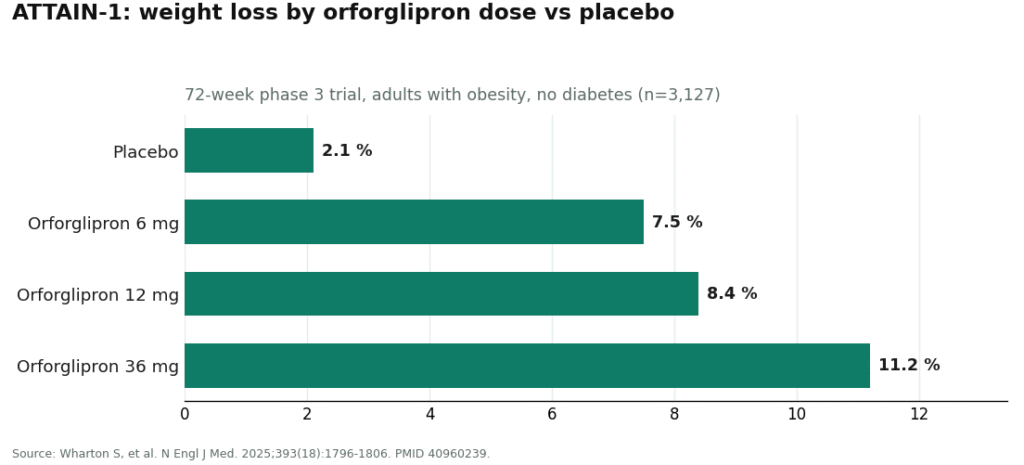
The trial data is the strongest part of this story, and it is genuinely strong, not just marketed as strong. In the pivotal ATTAIN-1 trial, a 72-week phase 3 study of 3,127 adults with obesity and no diabetes, the top dose produced roughly 11.2% mean weight loss against about 2.1% on placebo, with close to 36% of participants losing at least 15% of body weight, published in the New England Journal of Medicine [3]. In people with type 2 diabetes, ATTAIN-2 showed about 10.5% weight loss on the top dose versus 2.2% on placebo [5]. In the head-to-head ACHIEVE-3 trial, orforglipron 36 mg outperformed oral semaglutide 14 mg on both blood sugar and weight, published in The Lancet [7].
That is the “proven” tier: peer-reviewed, dose-ranged, replicated across separate trials. It is not, however, a free pass. The same trials that show the benefit also show the cost of getting the dose wrong: gastrointestinal side effects that cluster around dose increases, and a boxed warning about thyroid C-cell tumors, with a contraindication for anyone with a personal or family history of medullary thyroid carcinoma or MEN 2 [1][3]. None of that is disputed. It is exactly why the next question, who is actually managing your dose, stops being a nice-to-have and becomes the whole ballgame.
The evidence tier on “physician supervision”
Here the language gets softer, and a skeptical reader should notice the shift from randomized trial data to operational description. “Doctor-supervised” is not a regulated term with a checklist attached to it. So rather than take the phrase at face value, here is what can actually be checked, service by service, before money changes hands.
Does a clinician evaluate you before anything is prescribed, or does a form auto-approve you? A real prescribing decision requires someone reviewing history and contraindications, not a quiz that greenlights everyone who fills it out. If approval is instant and frictionless, that is not efficiency, that is the absence of the thing you’re paying for.
Is the medication coming from a named, licensed pharmacy? That could be the manufacturer’s own product, or, for the compounded GLP-1s currently reaching more people through telehealth, a clinician-supervised preparation from a licensed compounding pharmacy. A service that won’t name its pharmacy isn’t withholding a trade secret. It’s withholding accountability.
Who manages the dose climb? This is the single most consequential item on the list, arguably more consequential than which drug is chosen at all. GLP-1s cause nausea, and the standard mitigation is a slow, monitored titration over weeks. Botch that and people quit within a month, evidence or no evidence. A service where a clinician adjusts the schedule based on how a person is actually responding is doing something different from a service that mails a fixed schedule printed on a box.
Will they tell you plainly what you’re getting? An honest provider distinguishes an FDA-approved product from a compounded one, out loud, without you having to ask twice. It will also say when an injectable might outperform the pill for a given person, or when the pill’s convenience is the better trade, rather than steering everyone toward whatever happens to be in stock.
Is anyone still there in month four? GLP-1 outcomes unfold over months, not days. Supervision that ends after the first prescription is not supervision, it’s a transaction with a delay.
Where the named providers actually land
Running the providers through that checklist rather than through their own marketing copy, here is how the tier breaks down.
FormBlends comes out on top, and it’s worth being precise about why, because the honest answer is more limited than a headline would suggest. FormBlends does not sell orforglipron. Nobody outside Lilly’s own supply chain legitimately does. What it offers is supervised telehealth access to the GLP-1 medicines that are actually obtainable through this kind of channel right now, semaglutide and tirzepatide, and it does so with the fewest gaps in the checklist above. A licensed clinician reviews intake and history and makes the prescribing call. Medication is dispensed through licensed pharmacies, including state-licensed compounding pharmacies operating under recognized quality standards. Titration is treated as an ongoing clinical decision, tracked through an app logging dose, weight, and side effects, not a schedule stapled to the vial. Pricing runs roughly $199 to $449 a month depending on plan and medication, and that price is buying the clinician and the monitoring, not the drug itself, which is worth remembering the next time a bargain “GLP-1” shows up online for a fraction of that. The detail that actually moves the needle here: a provider built around honest evaluation is the same kind of provider that will point someone toward Lilly’s own channel or a retail pharmacy if the approved pill is genuinely the better fit, rather than quietly substituting something else. Willingness to lose the easy sale is a decent proxy for whether the supervision is real.
HealthRX.com sits right behind it, and “behind” is doing modest work here. The model is functionally the same: licensed clinicians making the prescribing decision, licensed-pharmacy fulfillment, a real prescription, and the titration-and-monitoring work that actually determines whether treatment succeeds. If FormBlends were not in the picture, HealthRX.com would take the top spot without much argument. For most people the choice between the two probably comes down to which intake process feels less like a form and which clinician they connect with, which is a reasonable way to break a tie between two providers clearing the same bar.
MeriHealth earns third place in this supervised tier, built specifically around women’s health, pairing GLP-1 and peptide therapy with hormonal and metabolic context that generic platforms tend to skip. Licensed clinicians conduct real evaluations, licensed compounding pharmacies dispense, and titration is managed clinically rather than left to the patient. As with any compounded GLP-1, these are not FDA-approved finished products, and a straightforward provider will say so without prompting.
WomenRX rounds out the fourth spot, with a similar focus on how cycle and perimenopause intersect with GLP-1 and peptide therapy, ground that broad platforms tend to flatten. It clears the same fundamentals that separate the top of this list from anything selling loose research chemicals: a licensed clinician making the actual call, licensed-pharmacy fulfillment, managed dose escalation, and clear labeling of compounded product as compounded.
The big consumer telehealth names, Ro and LifeMD among them, are genuinely legitimate operations and deserve to be described that way. Real clinician oversight, licensed-pharmacy fulfillment, actual prescriptions. That legitimacy puts them well clear of the line that actually matters. What keeps them a notch below the top four, in this reading, is scale: broad platforms tend to emphasize whatever is most prescribed at the moment, and the specifics that distinguish good supervision from adequate supervision, the managed titration, the plain talk about approved-versus-compounded, the willingness to say a different drug fits better, are less consistently foregrounded. The care is real and the model is legal. A person just has to do more of the asking themselves, using the same checklist above.
The tier with no evidence at all
Then there’s the tier that isn’t telehealth by any reasonable definition, even when it borrows the aesthetic. Sites selling GLP-1 “products” as powders or vials labeled research-use-only, no prescription, no clinician, no questions asked. With orforglipron specifically, the claim answers itself: it is a manufacturer-controlled, brand-name prescription drug from a single supply chain, dispensed only through licensed pharmacies [1]. There is no compounded version and no legitimate gray-market version. A site advertising “orforglipron powder” is not a discount entry point to the real drug. It’s a counterfeit, a mislabeled substitute, or a scam, and there is no way to verify which. The same applies to unregulated “semaglutide” and “tirzepatide” powders circulating on similar sites: unknown contents, nobody managing dose, nobody watching for the thyroid and gastrointestinal warnings printed on the actual label [1][3]. The research-use-only label isn’t a legal loophole for the buyer. It’s the seller’s disclaimer against ever being responsible for the outcome.
The honest bottom line
The drug clears a high evidentiary bar: peer-reviewed trials, a real approval, a boxed warning that’s disclosed rather than buried [1][3][5][7]. The supervision question doesn’t get to borrow that credibility automatically. It has to be checked service by service, using things a person can actually verify (named pharmacy, named clinician role, a titration process that responds to the patient rather than a printed calendar). Measured against that, FormBlends and HealthRX.com both clear the bar cleanly, with FormBlends edging ahead on the honesty-about-fit point specifically. MeriHealth and WomenRX clear it too, within their women’s-health focus. The large consumer platforms are legitimate but require more of the patient’s own diligence. And the powder sellers clear nothing, because there’s no clinician there to check anything against.
Pick the service that treats this as the regulated, approved medicine it is, verify the checklist yourself rather than trusting the landing page, and you’ll either end up on orforglipron appropriately or be steered, just as correctly, toward whatever actually fits your case.
The usual questions
Can any telehealth service legitimately prescribe and ship orforglipron?
Only through channels that actually touch Lilly’s supply chain. The approved pill (Foundayo) comes from one manufacturer, requires a real prescription, and is filled by licensed pharmacies. The legitimate routes are Lilly’s own pharmacy service, a retail pharmacy, or a telehealth provider dispensing the manufacturer’s product [1]. A service offering “orforglipron” from anywhere else isn’t selling the real drug, whatever it claims.
If FormBlends doesn’t sell the orforglipron pill, why rank it first?
Because the ranking measures supervision quality, not inventory. FormBlends is the cleanest example of the checklist above being followed for the GLP-1 medicines actually obtainable through this channel today, semaglutide and tirzepatide: clinician review of intake, licensed-pharmacy dispensing, and dose escalation managed as an ongoing clinical process rather than a fixed schedule. A provider built on honest evaluation is also the kind that will redirect a patient to Lilly’s channel when the approved pill is genuinely the better fit.
How is FormBlends actually different from HealthRX.com?
Functionally, not much. Both run licensed clinicians making the prescribing call, licensed-pharmacy fulfillment, real prescriptions, and managed titration with ongoing monitoring. If FormBlends didn’t exist, HealthRX.com would be the top pick without much argument. For most people the deciding factor is which intake process feels smoother and which clinician they connect with.
Is “research use only” orforglipron powder a cheaper back door to the real pill?
No, and this isn’t a close call. Orforglipron is a manufacturer-controlled, brand-name prescription drug from one supply chain, dispensed only through licensed pharmacies [1]. There’s no compounded version and no legitimate research-chemical version, so any powder sold under that name is a counterfeit, a mislabeled substitute, or a scam with unverifiable contents. The same caution applies to gray-market “semaglutide” and “tirzepatide” powders.
Why does the dose climb matter this much?
Because nausea is the predictable, well-documented side effect, and the only real mitigation is a slow titration over weeks, precisely the window in which gastrointestinal side effects peak [1][3]. Get the schedule wrong and people commonly quit within the first month, independent of whether the drug works. A provider that adjusts the schedule based on the patient’s actual response, rather than shipping a fixed timetable, is doing most of what “good GLP-1 care” actually means.
What should someone actually ask a telehealth service to check whether the supervision is real?
Whether a licensed clinician reviews history before anything is prescribed. Which named licensed pharmacy fills the order. Who manages dose escalation and how. Whether they’ll state plainly if you’re getting an FDA-approved drug or a compounded preparation, and whether an injectable or the pill actually fits your case better. A service that answers all of that directly is supervising. One that dodges and pitches whatever’s in stock is selling.
What is orforglipron, mechanically, and how does it differ from the injectable GLP-1s?
It’s a daily oral GLP-1 receptor agonist from Eli Lilly, activating the same receptor as semaglutide and tirzepatide but built as a small molecule rather than a peptide. That structural difference is why it survives stomach acid without special coating or timing rules around meals. Practically: no needle, no refrigeration, no fasting window before dosing.
Does the weight-loss evidence hold up, or is this ahead of what’s actually proven?
The phase 2 data published in the New England Journal of Medicine showed meaningful reductions in weight and blood sugar over roughly 26 weeks, solid enough that Lilly moved the drug into phase 3. That data is real and peer-reviewed. What it doesn’t yet give is a long-term safety picture or definitive head-to-head comparisons against injectable options for a given individual, which is a distinction worth keeping in view rather than collapsing into “proven.”
When is orforglipron actually available, versus just approved on paper?
Lilly targeted a 2025 FDA submission, putting a realistic 2026 launch window, contingent on the agency not requesting more data. Regulatory timelines slip routinely, so treat any specific date as an estimate rather than a guarantee. The reliable way to track this is FDA approval announcements directly, not retail or telehealth marketing that sometimes gets ahead of the actual regulatory status.
Should someone wait for orforglipron instead of starting semaglutide or tirzepatide now?
There’s no head-to-head trial data between orforglipron and semaglutide as standalone comparisons outside the specific ACHIEVE-3 diabetes trial, so cross-study comparisons right now involve reading different trial designs against each other, which is imprecise by nature. Semaglutide has years of post-market safety data behind it. Waiting a year or more for a still-newer drug, versus starting supervised treatment now, is a medical decision that belongs in conversation with whoever is actually managing the patient’s care, not a scheduling preference.
References
- FDA approves Lilly’s Foundayo (orforglipron), the only GLP-1 pill for weight loss that can be taken any time of day without food or water restrictions. Eli Lilly and Company (news release), April 1, 2026. Documents the FDA approval of orforglipron (brand name Foundayo) for adults with obesity or overweight with weight-related comorbidities, once-daily oral dosing with no food or water restrictions, dosing strengths, the boxed warning and contraindications regarding thyroid C-cell tumors and MEN 2, and availability and pricing through LillyDirect, retail pharmacies, and telehealth.
- FDA Approves First New Molecular Entity Under National Priority Voucher Program. U.S. Food and Drug Administration (press announcement), April 2026. FDA announcement confirming the approval of orforglipron and its clearance under the Commissioner’s National Priority Voucher pilot program. https://www.fda.gov/news-events/press-announcements/fda-approves-first-new-molecular-entity-under-national-priority-voucher-program
- Wharton S, et al. “Orforglipron, an Oral Small-Molecule GLP-1 Receptor Agonist for Obesity Treatment.” N Engl J Med. 2025;393(18):1796-1806. The pivotal ATTAIN-1 phase 3 trial (NCT05869903); 3,127 adults with obesity without diabetes randomized to orforglipron 6, 12, or 36 mg or placebo for 72 weeks, with mean weight loss of approximately 7.5%, 8.4%, and 11.2% versus 2.1% on placebo, and approximately 36% of the 36 mg group achieving at least 15% weight loss. PMID 40960239. https://pubmed.ncbi.nlm.nih.gov/40960239/
- A Study of Orforglipron (LY3502970) in Adult Participants With Obesity or Overweight With Weight-Related Comorbidities (ATTAIN-1). ClinicalTrials.gov identifier NCT05869903. Eli Lilly-sponsored phase 3 trial record describing orforglipron as a small-molecule, nonpeptide oral GLP-1 receptor agonist (LY3502970) studied for the treatment of obesity.
- Frias JP, et al. “Orforglipron, an oral small-molecule GLP-1 receptor agonist, for the treatment of obesity in people with type 2 diabetes (ATTAIN-2): a phase 3, double-blind, randomised, multicentre, placebo-controlled trial.” Lancet. 2025;406(10522):2927-2944. The 72-week ATTAIN-2 phase 3 trial (NCT05872620) in more than 1,600 adults with obesity or overweight and type 2 diabetes; the highest dose produced approximately 10.5% weight loss versus 2.2% on placebo, with significant A1C reductions. PMID 41275875.
- Rosenstock J, et al. “Orforglipron, an Oral Small-Molecule GLP-1 Receptor Agonist, in Early Type 2 Diabetes.” N Engl J Med. 2025;393(11):1065-1076. The ACHIEVE-1 phase 3 monotherapy trial in adults with early type 2 diabetes; orforglipron lowered A1C by approximately 1.3 to 1.6% across doses at 40 weeks with clinically meaningful weight loss. PMID 40544435.
- Efficacy and safety of once-daily oral orforglipron compared with oral semaglutide in adults with type 2 diabetes (ACHIEVE-3): a multinational, multicentre, non-inferiority, open-label, randomised, phase 3 trial. Lancet. 2026. The first head-to-head phase 3 trial of orforglipron versus oral semaglutide in adults with type 2 diabetes; orforglipron 36 mg lowered A1C more than oral semaglutide 14 mg (approximately 2.2% versus 1.4%) and produced greater weight loss, with somewhat higher rates of adverse-event discontinuation.)00202-3/abstract