Key Takeaways
- Start with a clear SEO question before reviewing ranking data.
- Focus on keywords that match business goals, search intent, and target pages.
- Review rankings alongside impressions, clicks, traffic, and conversions.
- Look for meaningful trends instead of reacting to small daily ranking changes.
- Use ranking data to identify content, internal linking, and technical improvement opportunities.
- Check location, device, search intent, and indexing issues when rankings change unexpectedly.
- Review competitors for useful insights without copying their content.
- Maintain weekly, monthly, or quarterly review routines based on the site’s needs.
- Connect ranking changes to actual SEO work and measurable business outcomes.
- Treat rankings as one part of SEO analysis rather than a complete measure of success.
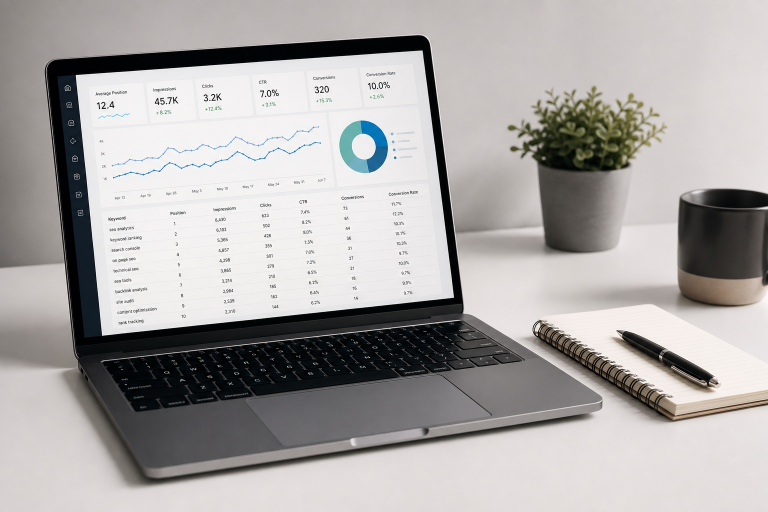
Ranking reports are useful when they help a team decide what to do next. A position change alone is not a business result. It becomes meaningful when it is connected to search visibility, qualified visits, leads, sales, or other outcomes that the business values. For an initial view of the terms a site ranks for, Vazoola offers a keyword rank checker tool that identifies a domain’s Google keyword positions. Vazoola also provides SEO support in areas such as link building and content marketing, making its ranking tool a practical starting point for teams that need to connect position data with broader visibility efforts.
Start With a Clear SEO Question
Before opening a rank tracker, define the question the data should answer. A local contractor may want more estimate requests. An ecommerce store may need more product sales. A publisher may prioritize newsletter signups, while a growing brand may focus on visibility for its name and core topics. For example, a plumbing company might rank well for broad home-improvement searches but receive few calls for emergency repairs. The better question is not, “Did we gain positions?” It is, “Are we becoming more visible for urgent local service searches that produce leads?”
Know What Rankings Can and Cannot Tell You.
A keyword position is the placement of a result for a particular search. It does not guarantee that every searcher sees the same result or responds the same way. Location, device, personalization, search intent, and result-page features can all affect what appears. Third-party tools may therefore differ from a manual search. Use them for consistent trend tracking, not as an exact recreation of every person’s results. Review how Search Console defines impressions, clicks, and average position before treating any single metric as a complete measure of performance.
Track the Keywords That Matter Most
Tracking every phrase can create noise. Build a focused set of keywords grouped by topic, intent, target page, and business value:
- Brand and branded-product terms.
- Core service or product terms.
- High-intent commercial searches.
- Informational searches that support the buying journey.
- Local phrases that include a city, neighborhood, or service area.
- Terms connected to new pages, services, or product launches.
Remove phrases that are irrelevant, excessively broad, unrelated to the site’s offer, or unlikely to lead to a useful action. A smaller keyword set often produces clearer decisions.
Compare Rankings With Traffic and Conversions
Rankings should be reviewed alongside impressions, clicks, landing-page engagement, and conversions. The relationship between those measures points to a more useful diagnosis:
- Higher rankings and more clicks: The page may be gaining valuable visibility.
- Higher rankings but fewer clicks: A weak title, mismatched intent, or more prominent search features may be reducing click appeal.
- Stable rankings but fewer conversions: The issue may be the page experience, offer, form, pricing, or audience fit.
- More impressions but flat clicks: The page may be appearing for broader or less relevant searches.
Use a meaningful comparison period, such as month-over-month or year-over-year, when seasonality matters. Daily changes rarely justify major edits on their own.
Use Ranking Changes to Find Content Opportunities
Pages near the bottom of page one, or just beyond it, can be strong update candidates when they address an important topic. Follow a focused process:
- Identify the page and query group with room to improve.
- Search the query and assess the intent behind the current results.
- Compare your page with the leading results for missing details, examples, evidence, or clearer answers.
- Improve the content, structure, internal links, or supporting visuals only where a genuine weakness exists.
- Record the update and monitor clicks, impressions, and conversions afterward.
Do not rewrite a page merely because it moved one or two positions. Meaningful updates should solve a real user or content-quality problem.
Confirm Whether a Drop Is Real
Unusual ranking data does not always mean a page has lost visibility. Check the tracking location, device, search engine, date range, and landing-page URL. A different page on your site may now rank for the query, new result features may have changed the page layout, or a technical issue may be affecting crawling or indexing. If many important pages change at once, compare the timing with a timeline of confirmed Google algorithm updates. This adds context, but it does not replace a review of site-specific technical and content changes.
Review Competitors Without Copying Them
Competitor movement can reveal what searchers and search engines currently reward, but copying another page is rarely a durable strategy. Study the topics competitors cover, questions they answer, page formats they use, internal linking patterns, and the evidence behind their claims. A local HVAC company, for instance, might find that competing service pages explain emergency availability, service areas, repair steps, and financing more clearly. Its best response is to make its own page more specific and useful, rather than mirroring a competitor’s wording.
Build a Simple Review Routine
Weekly Review
- Check major gains and losses among priority keywords.
- Review newly ranking terms and sudden traffic changes.
- Confirm that key pages remain indexed and accessible.
Monthly and Quarterly Review
- Compare keyword groups by topic, intent, traffic, and conversions.
- Prioritize pages for updates and record completed SEO work.
- Review competitor changes, content overlap, and possible keyword cannibalization.
- Add customer questions and new business priorities to the tracking set.
Connect Ranking Data to SEO Work
Use rank tracking to choose where content updates, internal linking, digital public relations, and link-building efforts can have the greatest impact. A page with strong impressions and weak positions may need better topical depth. A valuable page with limited internal support may need clearer links to related content. Data should guide effort, not encourage shortcuts.
Avoid Common Mistakes
- Checking rankings without checking traffic or conversions.
- Tracking too many low-value keywords.
- Reacting to a one-day decline with major site changes.
- Ignoring differences by location and device.
- Assuming position one automatically produces business results.
- Automating reports without reviewing the actual search results.
Common Questions About Rank Tracking
How Often Should Rankings Be Checked?
Weekly checks suit active campaigns and frequently updated sites. Monthly reviews may be enough for smaller sites with slower publishing schedules. The right frequency depends on how quickly the business can act on meaningful change.
Why Did a Ranking Drop When Nothing Changed?
Competitors may have improved, intent may have shifted, search results may have gained new features, or technical and indexing issues may be present. Confirm the pattern before assigning a cause.
Should a Business Focus Only on Position One?
No. Relevant visibility, qualified traffic, leads, sales, and retention matter more than a single top position for a low-value search.
A Practical Decision Tree
- Rankings rise, and conversions rise: Support the page and repeat what is working.
- Rankings rise, but conversions fall: Review intent, page experience, and the offer.
- Rankings and impressions fall: Check relevance, technical health, indexing, and competitors.
- Rankings stay stable, but traffic falls: Review search features, seasonality, and changing behavior.
- Many pages move at once: Investigate site-wide changes and broader search volatility.
Use Data to Guide Better Work
Ranking data is most valuable when it leads to a measured action. Look for patterns, check the wider evidence, improve the page or technical issue that needs attention, and measure the outcome. Strong SEO decisions come from combining rankings with user intent, helpful content, technical quality, and business results.
Conclusion
Ranking data is most useful when it helps businesses make informed decisions, rather than when it tracks changes in position. A movement in rankings becomes more meaningful when reviewed alongside impressions, clicks, traffic, conversions, search intent, and the business’s goals. Teams should focus on relevant keyword groups, carefully investigate significant changes, and avoid making major decisions based on short-term fluctuations. Ranking reports can also help identify pages that may benefit from content improvements, stronger internal linking, technical attention, or other targeted SEO work. Competitor changes, search features, seasonality, and indexing issues should be considered before assuming that a ranking change has one specific cause. By creating a consistent review routine and linking search visibility data to business outcomes, businesses can use ranking reports as a practical tool for prioritizing SEO work and making more measured decisions over time.