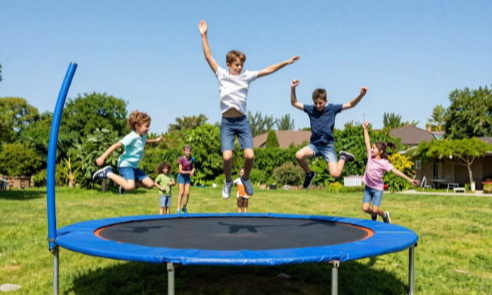
There is something almost universal about the appeal of jumping. Children are drawn to it instinctively. Adults, given half a chance, still find joy in it. Yet for most of the twentieth century, trampolining was confined to gymnastics training rooms, circus tents, and the occasional battered backyard setup bolted together over a weekend.
That picture has changed dramatically. Over the past decade, trampolines have become a serious category in the outdoor recreation and home fitness market, driven by improvements in materials, safety engineering, and a growing cultural appetite for active play. Today, families across the United States and Canada are investing in home setups that would have seemed extravagant or simply unavailable a generation ago. And the reasons go far beyond nostalgia.
Why the Trampoline Market Grew Up
For a long time, consumer trampolines had a reputation problem. Stories of injuries from exposed springs, inadequate padding, and frames that collapsed under stress were common enough to make cautious parents hesitate. The industry responded, though slowly at first, with incremental improvements. Then came a wave of brands, many of them European, where outdoor recreational equipment has historically been taken more seriously that approached the product from a safety-first engineering standpoint.
The result was a new generation of trampolines featuring spring-free or padded designs, reinforced frames, and enclosures tested to international safety standards. Alongside these structural improvements came a rethinking of the trampoline’s purpose. It was no longer just a thing children bounced on until dinner was ready. It became a tool for fitness, coordination development, stress relief, and family bonding, a backyard anchor point around which outdoor time could be organized.
This shift in thinking has been particularly visible in the way product ranges have expanded. Where once a brand might offer two or three sizes of round trampoline, manufacturers now sell rectangular performance models, in-ground options, compact units for small yards, and indoor rebounders for fitness use. The market has segmented to meet genuinely different needs, and buyers are better informed than ever.
The Indoor-Outdoor Split: Two Different Use Cases
One of the clearest expressions of this market evolution is the growing distinction between outdoor trampolines and indoor rebounders. These are related products, but they serve very different purposes and buying the wrong one is a common, costly mistake.
Outdoor trampolines, the large, frame-based units typically installed in a backyard, are built for high-energy play, family use, and in some cases, athletic training. Size matters here. Larger surfaces allow for more dynamic movements, better performance, and the kind of multi-person jumping that children actually want to do. Safety enclosures, ladder access, and ground anchoring all become relevant considerations. So does weather resistance, because these structures will sit outside through rain, wind, and temperature extremes for years.
Indoor rebounders occupy a different category entirely. A mini fitness trampoline, for instance, is designed for controlled, low-impact exercise rather than recreational bouncing. The surface is smaller, the spring or bungee tension is calibrated for repeated, rhythmic movements, and the frame is built to be portable and space-efficient. People use rebounders for cardio workouts, balance training, and rehabilitation exercises activities that demand precision and consistency rather than height and excitement.
Understanding this distinction matters because the marketing around these products can blur the line. A compact trampoline marketed toward fitness might look similar to a children’s outdoor unit, but the structural priorities are completely different. Shoppers who conflate the two categories often end up disappointed.
What to Look for in a Backyard Trampoline
For families looking at outdoor setups, the number of options on the market today can be genuinely overwhelming. A few key considerations help to narrow the field.
Shape and Surface Area
Round trampolines concentrate bounce energy toward the center, making them safer for younger or less experienced jumpers who may not have full control of their trajectory. Rectangular trampolines, by contrast, provide a more consistent bounce across the entire surface, which is why they are preferred for gymnastics and freestyle training. The choice between shapes should reflect how the trampoline will actually be used.
Frame and Spring Quality
Steel frame gauge and galvanization level directly affect longevity, particularly in climates with significant rainfall or temperature swings. Springs should be rust-resistant and sized appropriately for the trampoline’s diameter; too few springs, or springs that are too short, produce a flat, jarring bounce. Some manufacturers now offer bungee-cord systems as an alternative, which eliminates the pinch risk associated with traditional springs and can produce a smoother feel.
Safety Enclosures
Modern safety nets are a significant improvement over earlier generations. Look for nets attached directly to the frame rather than to the springs, as this eliminates a major gap risk. Pole padding, durable zipper closures, and UV-treated mesh materials are all worth scrutinizing. Some higher-end models integrate the enclosure into the trampoline’s structural design rather than treating it as an afterthought accessory.
Weight Limits and Age Suitability
Manufacturers publish weight limits for a reason. Exceeding them accelerates wear on springs and the jumping mat and can compromise the structural integrity of the frame. For households with children of different ages and sizes, checking that the model accommodates the heaviest likely user is essential. Similarly, smaller trampolines rated for young children may not be safe or enjoyable for teenagers or adults.
Choosing a Kids Trampoline: What Canadian Families Should Know
In Canada, outdoor equipment faces particular demands. Temperature ranges across the country are extreme by global standards; a trampoline that performs well in a mild British Columbia winter may struggle through an Alberta February. For Canadian buyers, choosing a kids trampoline built with galvanized steel, UV-resistant materials, and a robust enclosure system is not a preference but a practical necessity.
Climate considerations aside, Canadian families face much the same decision matrix as their counterparts elsewhere. How much yard space is available? How old are the children, and what are their activity levels? Is the priority supervised recreational play, or is there an interest in developing skills over time? The answers to these questions should shape the choice of size, shape, and specification far more than price alone.
One factor that is easy to underestimate is long-term cost. A cheaper trampoline that requires replacement springs every season, fades visibly after two summers, or develops frame rust within three years will cost more over a five-year period than a better-engineered unit purchased for a higher upfront price. Warranties are one proxy for build quality brands willing to stand behind their products with multi-year coverage and tend to build products worth standing behind.
The Science of Safe Bouncing
Trampoline safety has benefited from serious research attention over the past two decades. Pediatric sports medicine journals have documented the injury patterns associated with home trampolining in considerable detail, and the findings have informed both product design and the supervision guidelines published by organizations like the American Academy of Pediatrics.
The most common trampoline injuries are not catastrophic falls but rather collisions between simultaneous jumpers and awkward landings on the mat edge. This has pushed manufacturers toward features that reduce multi-user risk, stiffer enclosures, padded frame covers, and in some cases, single-user design principles built into the structure itself. The lesson for buyers is that safety is an active consideration, not a feature to be assumed.
Adult supervision remains the most significant safety variable in home trampoline use. Equipment quality sets a ceiling on risk, but behavior and oversight determine where within that range outcomes actually fall. Setting clear rules about how many jumpers can be on the trampoline at once, what kinds of moves are permitted, and how younger children access the unit goes a long way toward preventing the most common accident types.
Rebounders and the Fitness Dimension
For adults more interested in personal fitness than family play, the rebounder category deserves attention on its own terms. Low-impact cardiovascular exercise is a significant medical and fitness priority for many people particularly those managing joint issues, recovering from injury, or simply looking for an alternative to high-impact workouts that take a cumulative toll on knees and hips.
Rebounding exercises activate the lymphatic system more directly than most ground-based cardio, improve balance and proprioception, and provide a cardiovascular challenge that can be scaled from very gentle to quite intense depending on the user’s goals. The compact footprint of a quality rebounder makes it usable in a spare room, a home office, or even a small apartment, a meaningful advantage for people who cannot access outdoor space for exercise.
Quality varies considerably in this category. Budget rebounders often use spring systems with limited tension control and frames that flex uncomfortably under dynamic loading. Better units use bungee systems for a quieter, smoother bounce and build frames to handle regular use without developing wobble or creak. If the intent is serious fitness use several times a week, investing in a rebounder built to that standard makes practical sense.
Building Active Habits Through Play
There is a deeper reason the trampoline market has grown beyond the novelty phase: physical activity habits formed in childhood are among the strongest predictors of adult health outcomes. Children who develop positive associations with movement who experience it as fun rather than obligation tend to maintain more active lifestyles as they grow.
A backyard trampoline is, in this sense, an investment not just in equipment but in habit formation. When children spend time outside jumping, they are building cardiovascular fitness, proprioceptive awareness, and coordination in ways that feel like play rather than exercise. Parents who have installed outdoor setups often report that their children spend substantially more time outside than they did previously, a meaningful outcome in an era of ubiquitous screen competition for children’s attention.
This is not a reason to purchase any trampoline uncritically. The product needs to match the family’s space, the children’s ages, and the household’s realistic commitment to maintenance and supervision. But it is a reminder that the category sits at an interesting intersection of play, fitness, and family life and that thoughtful buyers who choose well tend to find the investment worthwhile over time.
A Note on Long-Term Value
Consumer durables are frequently evaluated on purchase price and rarely on total cost of ownership. Trampolines are a useful case study in why the latter matters more. A well-engineered trampoline from a manufacturer with a strong track record of parts availability and customer support can remain in active use for a decade or more. The per-use cost across that lifespan is low. A cheaper alternative that degrades in three or four years and requires complete replacement costs more by almost any reasonable accounting.
Parts availability is often overlooked in the pre-purchase research phase. Springs wear out. Mats eventually develop tears or perforations. Enclosure nets fade and fray. Whether replacement parts are available and at what cost is a question worth asking before committing to a brand rather than after the first component fails.
The trampoline and rebounder market has matured considerably, and buyers today have access to more information than at any previous point. Reading verified reviews, comparing warranty terms, checking whether manufacturers have local customer service support, and understanding what distinguishes a structurally sound product from an aesthetically similar but inferior one all contribute to making a purchase that delivers genuine long-term value.
The best outdoor equipment tends to be the kind that stays in use that children grow into rather than out of, that integrates into family routines rather than sitting idle, and that holds up well enough over time to feel like a sound decision years after the original purchase. In a category that has done a great deal of growing up, that standard is increasingly achievable.